
Solving Financial Exclusion for Migrant Workers: Why We Invested in Yourpay
18 May, 2026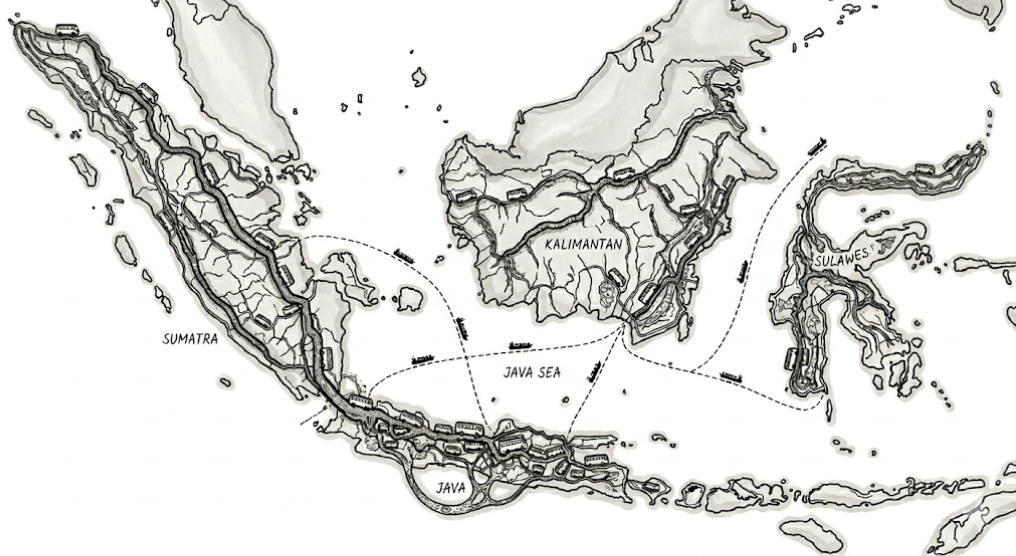

Fleet Intelligence in Indonesia: Why We Invested in McEasy
17 August, 2026
The Circulatory System
Indonesia is not a country so much as an archipelago of more than 17,000 islands, home to 280 million people, spread across a stretch of ocean wider than the continental United States. The rice that feeds Jakarta is harvested in Central Java. The LPG that cooks dinner in Surabaya is piped from a Sumatran refinery, loaded onto a tanker, and driven the last mile by truck. The cold chain keeping chicken fresh between slaughterhouse and supermarket depends on a refrigerated truck holding a precise temperature across six hours of Java's highway traffic.
Trucks and buses are the circulatory system of this country. There are 5.5 million of them on Indonesia's roads, operated by logistics companies, bus operators, food distributors, and cash-in-transit providers — most family-owned, most managing their fleets the same way they have for decades: dispatcher phone calls, paper logbooks, and a great deal of intuition and hope.
Most of us know the consumer version of this anxiety: Fedex's success was founded on giving consumers the reassurance of knowing exactly where in the world your package is and when you would likely receive it. For an online shopper, uncertainty is a minor inconvenience. For a fleet operator running 400 trucks carrying perishable cargo on a time-sensitive contract, uncertainty can mean spoilage, delays, contractual penalties and operational disruption. It is a potential operational crisis playing out daily.
McEasy is turning that uncertainty into actionable intelligence. And that is why we invested.
Beyond the Blinking Dot
When most people hear "fleet management software," they picture a map with blinking dots. That is where the industry started — GPS trackers that told you where your vehicles were. Useful, but barely scratching the surface.
The more interesting question is not where your truck is, but what is happening inside it. Is the driver drowsy, or drifting across lanes? Has the refrigerated cargo drifted above the safe temperature threshold? Is there fuel missing that should not be?
Telematics data compounds the more sensors you layer on. A motorcycle crashes into a refrigerated truck in the middle of the night on a remote country road: what really happened? Who was at fault? A GPS tracker tells you the truck had been traveling at a steady pace well below the speed limit. A dashboard camera tells you the driver was alert and focused. A door sensor tells you the cargo hold fell open at 2:53 am, but the camera tells you nothing fell out the door. Put those four data points together, and you have a complete incident report your insurer, your customer, and your lawyers can act on.
In McEasy's language, this is the difference between visibility and intelligence.
The Surabaya Approach
Raymond Sutjiono and Hendrik Ekowaluyo are, by their own description, not typical Indonesian startup founders. They grew up in Surabaya — Indonesia's second largest city, proud of its family business culture and deep suspicion of burn-first-think-later growth. They met at Purdue University, worked together at Ford Motor Company, and returned to Indonesia in 2015 to apply what they had learned to modernizing the country's vehicle industry.
They spent two years building McEasy on nights and weekends. When an early experiment with buy-now-pay-later device financing started fuelling growth at the cost of a ballooning receivables book, they shut it down and moved to requiring customer prepayments instead. Most founders in that position would have kept going.
Raymond calls this the "Surabaya approach": grow deliberately, earn trust through service quality, never confuse activity with progress. It is unfashionable in a venture ecosystem that has rewarded the opposite. It is also why McEasy is accelerating while better-funded competitors have stalled. Its contribution margin has climbed from 27% to nearly 58% over three years — not by burning the furniture, but by compounding.
The Land-and-Expand Flywheel
Speaking of compounding: of the incremental recurring revenue McEasy generated between early 2022 and mid-2025, only 17% came from new customers. The remaining 83% came from customer fleets growing, or customers upgrading to higher-value packages. By month 12, the average customer pays McEasy 4.7 times their day-one contract value. Customers expand because the data gets more useful the more sensors you add. And because once operations are built around a platform, switching costs are real.
When Customers Become Champions
But the most telling indicator of a great product is not the renewal rate, or even net revenue retention. We spent six days visiting McEasy customers across Jakarta and Surabaya. The most striking takeaway was the tone of the conversations.
One large customer that prided itself on being the standard-bearer in secured transportation pulled their contract from a large incumbent operator and gave it to McEasy because the competitor could not keep pace with their requirements. During our visit, the customer's team walked us through their secured storage and processing centre — an access, the customer's CEO told us, they had never extended to any other software vendor. They now actively promote McEasy to their own clients, and are co-developing custom packages of sensors to enhance visibility across their operations.
A Surabaya LPG distributor's VP of Operations told us he had scheduled an upcoming pitch to his former employer on McEasy's behalf. At a publicly traded transport company, the president director had seen such a clear reduction in accidents on camera-equipped trucks that he plans to install McEasy's full package on every new vehicle purchased.
This pattern — customers referring customers, co-developing products, mandating McEasy across their upstream supply chains — is the result of a mission-critical product priced at a tiny fraction of customers' cost base, and the savings it delivers. McEasy's subscription fees are roughly 3% of cost of goods sold for a leading cold chain logistics provider in Indonesia. For a company managing 1,000+ refrigerated trucks, that is not a line item anyone seriously considers cutting.
More Than a Subscription
The telematics business is the foundation on which McEasy's real moat is built: the thousands of vehicles whose operators have reorganised their workflows around McEasy's data.
McEasy knows how many kilometres each truck travels, how often its tyres need replacing, and which drivers are safety risks. And, from the pattern of sensor deactivations and reactivations, that roughly 5% of its installed base turns over annually as owners retire old trucks and buy new ones.
In mid-2024 it launched spare parts to its subscriber base. While it is naturally a thinner-margin business than telematics, for McEasy, it is a way to more deeply embed itself into its customers' operations, and to earn incremental dollars on the investment made in acquiring the customer in the first place. The cross-sell is working: more than 30% of spare parts buyers are existing telematics subscribers. Next on the roadmap: a used truck marketplace intermediating transactions already happening informally inside its ecosystem, and fleet insurance priced on its own behavioural data. A fleet whose drivers score well on McEasy's safety dashboard is a better insurance risk, and McEasy is one of the few companies in Indonesia that can prove it, vehicle by vehicle.
The Honest Case for the Bears
First, the telematics market in Indonesia is competitive. A well-capitalised competitor could replicate the hardware stack. What competitors have found harder to replicate is the firmware-software integration, the way McEasy's embedded firmware talks to its analytics platform, producing real-time incident detection and industry-specific dashboards that customers have built their operations around. Customers who switched to McEasy from alternatives explicitly cited the difference between the promised and actual capabilities of competitor' platforms as a key driver for their decision making. Off-the-shelf sensor integrations are unreliable and hard to customise, and switching away from something that is mission-critical, and, equally importantly, works well, is a real deterrent.
Second, the macro environment warrants watching. Currency depreciation compresses USD returns; government budget pressures could affect state-linked contracts. McEasy's revenue spans multiple sectors, which limits sector-specific exposure.
Third, hardware capex is real, and managing working capital as the spare parts business scales will require ongoing discipline. The founders' track record gives us comfort; their instincts on this have been sound.
Finally, the exit environment for Southeast Asian technology companies remains uncertain. The most plausible exit paths for McEasy are a strategic acquisition by a global player seeking an Indonesia foothold, a regional consolidation play as the fleet management landscape matures, or an insurance company that sees the value of McEasy's data. Neither is guaranteed on any particular timeline. What McEasy can control is building a business that any serious acquirer would find hard to ignore — and on that front, the trajectory is encouraging.
In Conclusion
Fewer than 5% of Indonesia's 5.5 million commercial vehicles are connected to an intelligent fleet management system. The remaining 95% is the opportunity. What McEasy has spent seven years building, is the right to serve it.
Raymond and Hendrik came back from Ford with an engineer's belief in precision, reliability, and well-designed systems. McEasy is starting to look like exactly that — quietly making Indonesia's roads more intelligent, one vehicle at a time.